

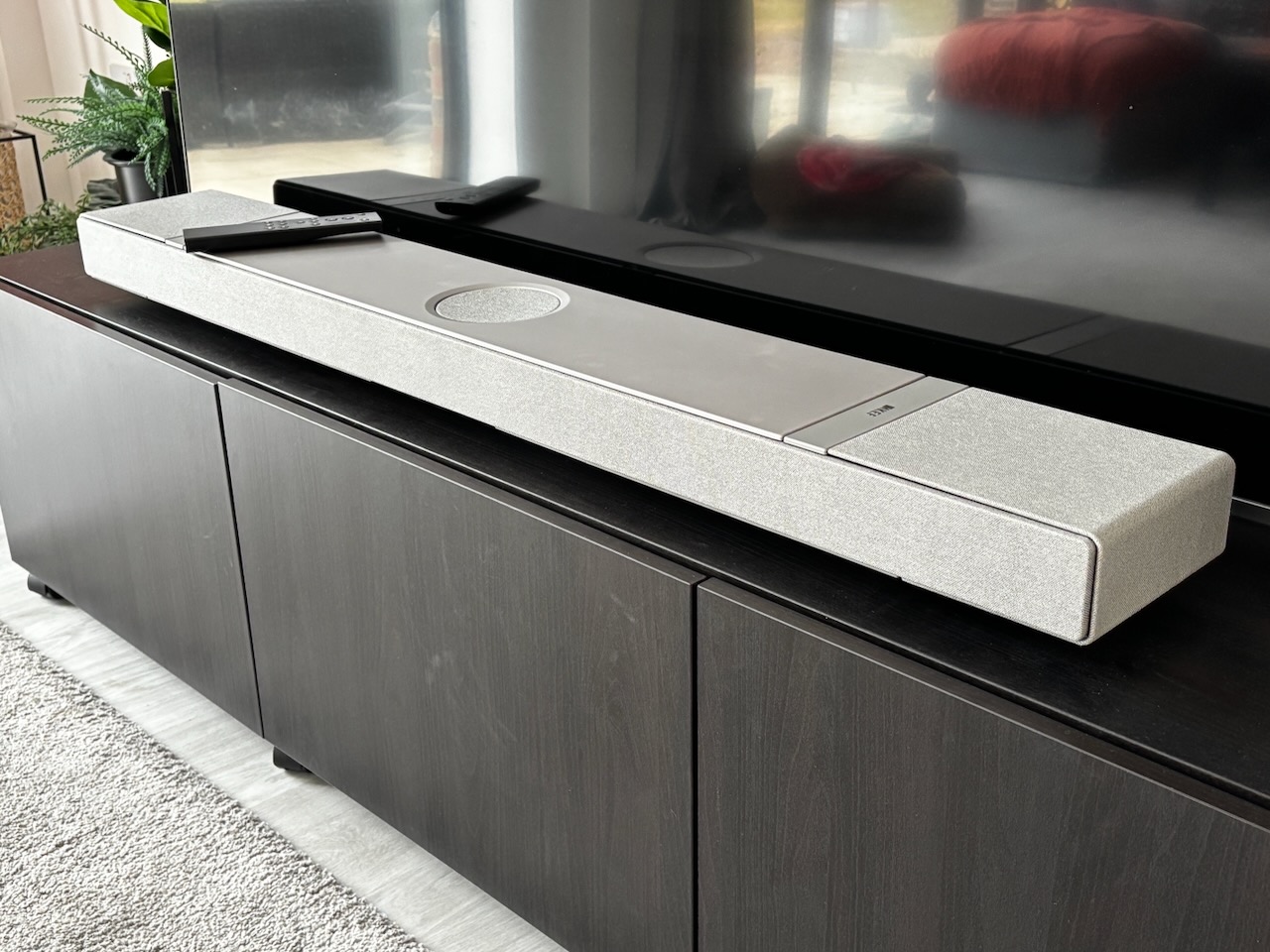
Tested at: £1999
There’s no getting away from it, the KEF XIO is an expensive proposition, especially for a standalone soundbar. Having said that, it’s also one of the select few that’s genuinely as skilled at reproducing stereo music, as it is conveying multichannel film soundtracks. If a soundbar that can excel at both of those tasks is your No.1 priority, then consider your search over: the XIO will deliver what you crave.
GOOD NEWS
- Immersive movie sound
- The most musical sounding soundbar at this price
- Well-organised app
BAD NEWS
- No display to indicate modes or volume levels
OUR RATING

What is the KEF XIO?
The XIO is a one-box, standalone soundbar that, according to its maker, offers a gateway to ‘transcendent, high-fidelity spatial audio’, and has been designed to offer ‘sound quality and performance that rival KEF’s renowned HiFi systems’, albeit for a lifestyle-focussed audience.
Offering 5.1.2-channel performance, the XIO integrates upwards firing speakers which, courtesy of KEF’s Music Integrity Engine (a suite of in-house developed DSP algorithms), recreate immersive Dolby Atmos height-channel effects via virtualisation processing (DTS:X, Sony 360 Reality Audio and AirPlay Spatial Audio codecs are also supported).
While the XIO comes without a subwoofer, Kef claims a bass response down to 34Hz, which should be plenty enough for most users. If you’d like to go still lower, there’s an analogue RCA subwoofer output on the rear panel, or you can purchase a package that also includes the Kef KC62 subwoofer and add-on wireless KW2 RX receiver.
KEF says dedicated wireless surround speakers, designed to be paired with the XIO to create a more expansive 7.1.2 system, are planned for launch later in 2025, with details and pricing to follow.
Design, setup and usability
This elegant looking device (available in silver grey or slate black) features 11 drive units, each driven by a Class-D amplifier, collectively capable of delivering an instantaneous power peak of 820W. Placed in a living room, it’s best partnered with 65in plus TVs as it looks a little absurd with smaller screens.
The three front-firing and two up-firing channels use a newly-developed, 50mm diameter version of KEF’s trademark UniQ drive unit, dubbed the MX. Low bass is handled by a quartet of lozenge-shaped 180mm wide P185 drivers, augmented by a patent-pending innovation called Velocity Control Technology (VECO). Essentially, this monitors the motion of the drive unit’s cone, sending the data into a negative feedback loop, the objective being to lessen distortion in the low frequencies. Lastly, there are a pair of 50mm diameter side-firing full-range drivers for left and right surround duties.
While the XIO can be turned through 90 degrees for wall-mounting (wall mounts are supplied as standard), you have to rotate it so that the cables enter and exit from the bottom, which results in a slightly messy arrangement. An array of built-in sensors, collectively dubbed Intelligent Placement Technology (IPT), automatically detect the unit’s orientation and reassign channels to different drivers, while adjusting the low frequencies to best suit the chosen option.
Regardless of how you position it under your TV, you’ll still guaranteed a 5.1.2-channel experience; that lone Uni-Q MX driver located in the centre of the top face only becomes functional – as a centre-channel driver – when the XIO is wall-mounted. But KEF’s VP of technology, Dr Jack Oclee-Brown, makes clear that to hear it at its best, the soundbar should be placed horizontally, preferably on a suitably deep sideboard/credenza.
When it comes to controlling and using the XIO, KEF has all the bases covered. On the top left of the unit itself, there are a basic set of illuminated manual touch-sensitive, augmented by a simple backlit remote control (with assignable EQ buttons) for when you’re seated.
Alternatively, you can simply fire up the excellent iOS/Android KEF Connect app, if you want to do anything more involved than switching and volume changing. This acts as a control hub for all the sources you might want to use, such as music streaming services, radio, podcasts and local UPnP media servers, as well as allowing you to customise your control options.
From a usability perspective, my main criticism is that there no way to be sure what EQ mode is engaged, unless you have the smartphone app open.
Sound quality
While there are six EQ presets available in the app, there aren’t much in the way of fine-tuning options beyond the initial EQ calibration. I mostly found myself sticking to the Default mode for general listening, the Movie mode when watching Dolby Atmos-encoded movies, and the Music setting for two-channel material.
As to how it performs, well, having listened to most of the standalone soundbars currently on the market, I can honestly say I was floored by the XIO’s sound quality; it’s stunning.
Spatially, the XIO throws around Atmos effects in an impressive fashion, but there are three things that it does spectacularly well. The first is that it creates a remarkably palpable, full-bodied, soundstage that’s distinctly tangible; by that I mean there’s easily perceivable depth, as well as width and height. Cheaper soundbars rarely manage to excel at all three of those aspects.
Recreating human voices accurately is the essential for centre-channel believability, so trust me when I say that I can’t recall hearing a soundbar so far that better pulls that particular trick off. Turn up the volume high, particularly if you’ve placed the XIO in a huge room, and you can hear just the faintest hint of raspiness creeping in but, at normal levels, speech just sounds natural and convincing.
The XIO’s second standout quality is its low-frequency clout. The Sound Motion drivers used in the latest Sonos Arc Ultra soundbar still set the standard in the sub-£1000 soundbar category, but the VECO technology KEF has developed appears to achieve even more at this admittedly elevated price point.
Tight, extended and well-defined, the XIO’s low frequency performance completely avoids the one-note bass trait that renders so many soundbars unlistenable, unless bolstered by a subwoofer. It’s rare that adding an external sub at least marginally doesn’t improve a soundbar’s performance, but here it’s absolutely not a ‘must have’.
If anything, you’re likely to conclude there’s a surfeit of bass here, but that’s fixable. The trick is simply to pretend in the app that you’ve got a subwoofer connected, and then move the soundbar/subwoofer balance slider to reduce/increase the XIO’s LF output.
Lastly, you won’t be surprised to hear that the XIO does a brilliant job with music. Aside from a slight softness in the upper bass, it’s tuneful and engaging in way that few soundbars, at any price, manage. Exactly what you might hope for from a debut model from one of the world’s leading hi-fi loudspeaker specialists.
Connectivity
The W2 wireless platform used by the XIO is an adaptation of the tried and tested one used for KEF’s LS-series wireless speakers. Which explains why it works so sweetly, delivering, as it does, a fuss-free way of enjoying all the major cloud-based music streaming services, including Spotify, Qobuz and Amazon Music, with AirPlay 2 provided for Apple Music fans.
At the rear of the unit you’ll find a physical power on/off switch plus a pairing control for your smartphone (using Bluetooth 5.3), a digital optical input, and a solitary eARC-enabled HDMI 2.1 socket. Which, I have to say, is a disappointment. Given the lofty price point, I would have expected a second passthrough HDMI to be provided, allowing the XIO to be used a central hub for sources, as opposed to a TV.
For the unhinged who crave even more bass than already on offer – and there’s a lot – there’s also an analogue RCA subwoofer output provided. If you’re as flush as you are crazy, and don’t fancy the idea of a physical interconnect running to a sub, you also have the – somewhat pricey – previously mentioned option of purchasing the XIO with a KEF KW2 wireless sender/KC62 subwoofer combo.
Specifications
- 15 amplifiers
- 14 drive units
- 1 x HDMI eARC
- 9.1.4-channels (emulated)
- Dimensions 117 (W) x 7.5 (H) x 11.6 (D) (cm)
- Weight 5.9kg
- Available in black or white
KEF XIO – FAQs
Can a £2000 soundbar possibly be classed as good value?
The XIO certainly isn’t cheap, especially given that it only offers 5.1.2-channel performance. But having now spent a couple of weeks with it, I’d have to say it genuinely sets a high standard for both music and movie sound – few soundbars handle both tasks with as much sonic panache.
What if I decide I want to go beyond 5.1.2-channel performance?
KEF will be launching wireless surround sound speakers to accompany the XIO later in 2025, so building a 7.1.2-channel system around it will definitely be possible.
How futureproofed is the XIO?
According to KEF’s Dr Jack Oclee-Brown, the XIO has more than enough memory and processing firepower to accommodate any foreseeable upcoming surround sound formats. That’s because it’s been designed from the outset to deal with demanding MPEG-H 3D Audio-based ecosystems, Sony’s 360 Reality Audio being the current, most high-profile example.
