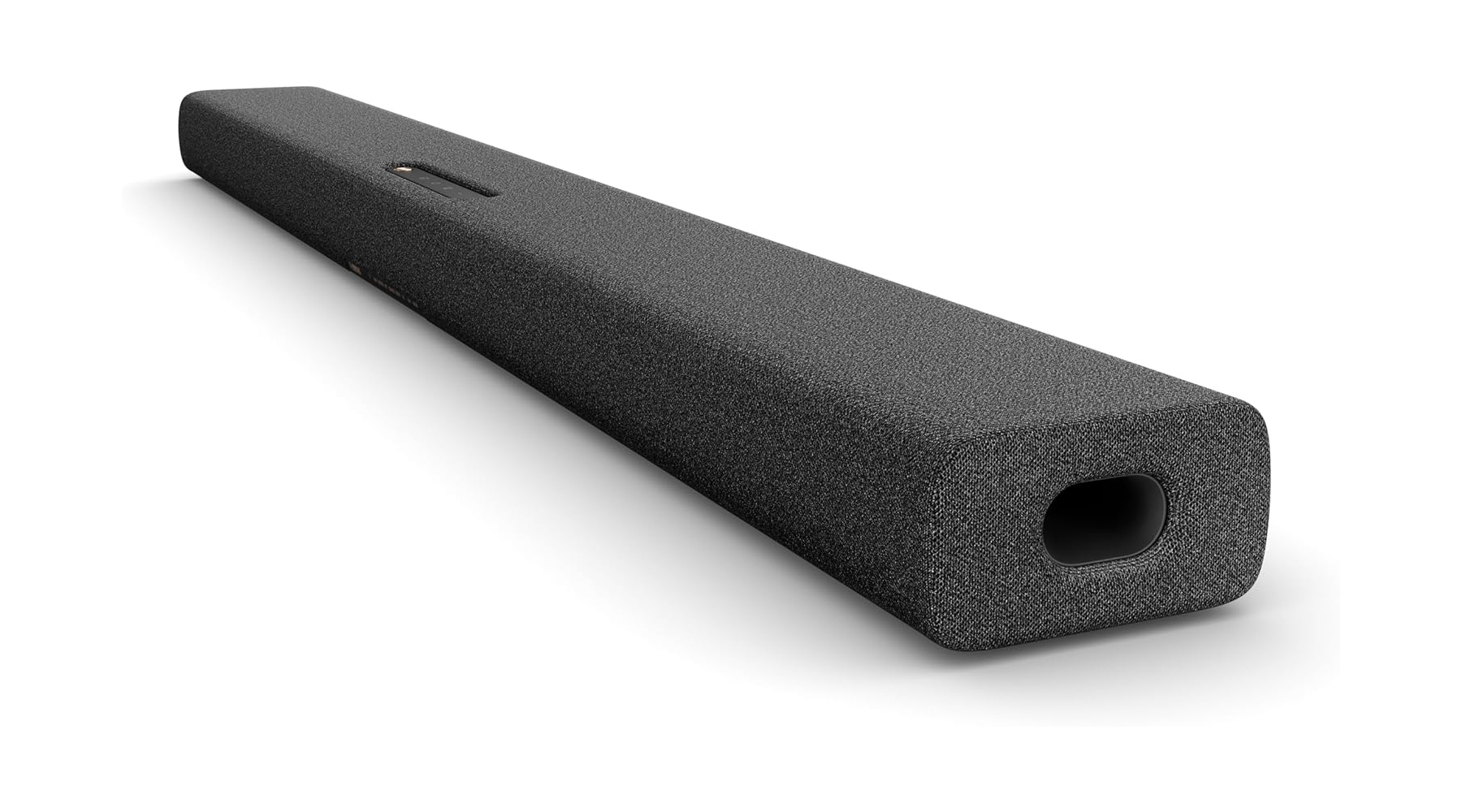
Nicely wrapped in a grey fabric, and seemingly recently heavily discounted, the SR-X40A sits comfortably under, and in front of most modern TVs, a touch-sensitive control panel at the top operating the basic functions. There’s also a well-featured, if somewhat featherweight remote control, as well as a basic app. Surprisingly, there’s no ability to tailor the audio output, beyond switching between the four DSP modes, and boosting bass.
All of the soundbar’s status info comes via a line of distractingly bright status LEDs plonked on the front face which, thankfully, they can be either dimmed, or switched off entirely. But it’s good to see that there’s at least an extra HDMI input as well as the expected eARC input and optical inputs, offering a degree of flexibility when it comes to accommodating sources.
As well as front-facing left and right channel drivers located at the ends of the side-ported soundbar, there’s a pair of angled, upward-facing drivers (to allegedly bounce Atmos effects off your ceiling) in the top face, plus a pair of subwoofers. Oddly, however, there are no dedicated drivers for the centre-channel.
Fed some content, the SR-X40A delivers a tonally well balanced and expansive 2D soundstage, one that spreads nice and wide, but it fails to project effects towards the listener with much conviction. Music sounds quite matter of fact and, thanks to that ‘phantom’ centre-channel arrangement, movie dialogue lacks focus and intelligibility.
While this is undoubtedly a smooth sounding device, it’s off the pace when it comes to immersiveness, certainly compared to the Sonos Beam (Gen 2). Have seen this heavily discounted in recent months, however, so it still merits consideration.